
A national retail brand rebuilt its field sales force from 40 to 210 reps across Canada in four months.

How a consumer goods company scaled its commercial team for a national product launch without disrupting existing account relationships.
Back to full production in six weeks and 12% above prior quarter output, with zero CFIA incidents.

How a national food processor recovered from a sudden 40% workforce loss without missing a single retail commitment.
63 specialized IT roles filled in 30 days and a $47M ERP delivered three weeks ahead of schedule.

How a federally regulated Crown corporation staffed a mission-critical technology program under bilingualism and security clearance constraints.
Seven new branches. Fully staffed from day one. Member satisfaction never moved.

How a fintech-backed credit union grew its operations team by 60% in under a year while maintaining award-winning service scores.
A 23-person engineering team stood up in six weeks to rescue a capital project running three months behind.

How a mid-market industrial firm recovered its project timeline and avoided $1.8M in projected delay penalties.
A 41% drop in line downtime and a $3.4M annualizedproductivity gain through a lean transformation that could notafford to slow down.

41% Reduction in line downtime 99.2% OEM quality pass rate $3.4M Annualized productivity gain 18months Engagement duration SITUATION A Tier 1 automotive component supplier was executing a full lean manufacturing transformation across threeproduction lines. The Kaizen program required frequent line reconfigurations, cross-functional workstationrotations, and continuous skill development, which meant their workforce needed to be flexible, […]
WSIB and Employment Standards Act: A Plain-English Guide for Canadian Employers Using Staffing Agencies
Quick Answer When you use a staffing agency, compliance works under a shared responsibility model. The agency is typically the employer of record for payroll, statutory deductions, and most Employment Standards Act obligations. You, as the host employer, carry co-responsibility under the Occupational Health and Safety Act for the safety of every worker on your […]
5 Workforce Planning Mistakes Canadian Operations Leaders Keep Making (And How to Fix Each One)

Quick Answer: The five most costly workforce planning mistakes in Canadian operations are: planning for average demand instead of peak demand, treating staffing as a last-minute problem, ignoring turnover lag in headcount models, siloing HR from operations in planning conversations, and choosing price over fit when selecting a staffing partner. Each one is fixable with […]
Temporary vs. Permanent Staffing: How to Choose the Right Model for Your Operation
Quick Answer Temporary staffing is right for seasonal demand, project-based work, budget uncertainty, and roles where fit is uncertain. Permanent hiring is right for core roles requiring institutional knowledge, significant training investment, and specialist positions. Temp-to-perm is the best mis-hire mitigation tool available to Canadian employers – it lets both parties evaluate fit with a […]
How AI Is Reshaping the Talent Pipeline Across Skilled Trades and IT: What Employers Need to Know
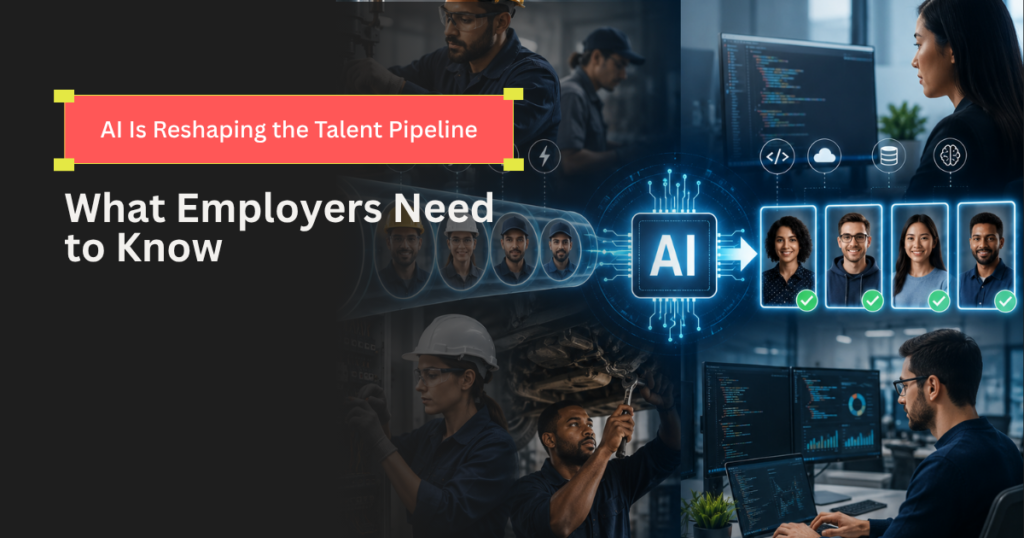
Quick Answer AI is improving trades and IT staffing in Canada by compressing credential verification from 10-14 days to 48 hours, flagging at-risk placements before they leave, and expanding the IT candidate pool through skills-based matching. It cannot assess practical skill quality or culture fit in either sector – those remain human judgment calls. Employers […]