
Quick answer: to find work in Canada as a new immigrant, understand where the jobs are, rewrite your resume in the Canadian format, get your foreign credentials assessed (a WES assessment costs about CAD $329 and takes roughly 35 business days), and build Canadian experience fast, often through a first job or a staffing agency, which is free to you. Get an in-demand certification, get your driver’s licence (Canada is short more than 20,000 truck drivers alone), network the Canadian way, prepare for behaviour-based interviews, and know your work rights. The ten steps below explain each in detail, with the numbers and official sources behind them.
Canada takes in a large, steady flow of newcomers, its 2026 to 2028 Immigration Levels Plan targets 380,000 new permanent residents a year, roughly 64% through economic categories. But arriving skilled and getting hired at your level are different things. In 2024 the recent-immigrant unemployment rate was about 11% (10.4% for core-working-age newcomers), nearly double the 5.6% for Canadian-born workers, and around a third of recent immigrants with a bachelor’s degree report being overqualified for the jobs they hold. That gap is rarely about ability; it is about knowing how the Canadian system works, and moving quickly on the steps that matter. This is the detailed playbook.
Last updated: July 2026.
What’s in this guide
- 1. Understand the Canadian Job Market
- 2. Rewrite Your Resume in the Canadian Format
- 3. Get Your Foreign Credentials Assessed
- 4. Build Canadian Experience and References
- 5. Register With a Staffing Agency
- 6. Get an In-Demand Certification
- 7. Get Your Canadian Driver’s Licence
- 8. Build a Canadian-Style Network
- 9. Prepare for Canadian-Style Interviews
- 10. Know Your Work Rights
- The Bottom Line
- The 10 Steps at a Glance
- Frequently Asked Questions
1. Understand the Canadian Job Market
Why it matters: Canadian hiring leans heavily on Canadian experience, references and networks, not credentials alone, which is exactly why skilled newcomers stall. Understanding that early shifts your strategy from “apply online and wait” (where immigrant unemployment sits near 11%) to “build local proof fast.” It also tells you where to aim: some sectors hire newcomers readily, others gate entry behind licensing.
What to do: Use the free Government of Canada Job Bank to see in-demand occupations and real wages in your province, and its wage tool to sanity-check offers. Warehousing, logistics, transportation and trucking, manufacturing, skilled trades and healthcare support are hiring steadily and are open to newcomers without years of Canadian history, which makes them a strong first foothold while you work toward your target field. Before anything else, apply for your Social Insurance Number (SIN) the moment you land, since you cannot legally be paid without it; it is free and can be done online or in person.
2. Rewrite Your Resume in the Canadian Format
Why it matters: This is where most newcomers are rejected before a human reads their experience. A resume built for another country often fails in Canada for two reasons: it breaks local conventions that recruiters expect, and it gets filtered out by the applicant tracking systems (ATS) most mid-size and large employers use to screen resumes for keywords before a person ever sees them. A strong Canadian resume clears both hurdles.
What a Canadian resume looks like:
- One to two pages. Not a multi-page academic CV. Cut anything older than 10 to 15 years unless directly relevant, and lead with your strongest, most recent experience.
- No photo and no personal details. Leave out your photo, age, date of birth, marital status, religion, nationality and any national ID number. These are normal in many countries but work against you here, because Canadian employers deliberately avoid anything tied to human-rights-protected grounds.
- Achievements with numbers, not duties. Write “cut picking errors 20%” or “supervised a team of 12 on a $2M project”, not “responsible for picking.” Canadian recruiters scan for measurable impact.
- Beat the ATS with keywords. Mirror the exact words in the job posting (job title, skills, tools). The screening software ranks resumes on keyword match, so a generic resume is filtered out before a recruiter sees it. Use a clean, single-column layout, standard headings and no tables or graphics, which many ATS cannot read.
- Local contact details. A Canadian mobile number and a simple name-based email signal you are here and reachable now. Add your city, but not your full street address.
- Canadian spelling and translated titles. Use Canadian spelling (“labour”, “organize”), drop country-specific jargon, and translate your job titles into their closest Canadian equivalent so a recruiter instantly understands the role.
Where to get help: You do not have to do this alone. Government-funded settlement agencies in every province offer free resume writing, and these services are funded by Immigration, Refugees and Citizenship Canada specifically to help newcomers get hired. Have your resume reviewed there before you send it out; it is one of the highest-return free resources available to you.
3. Get Your Foreign Credentials Assessed
Why it matters: Employers and regulators often cannot interpret a foreign degree or licence, and in regulated professions, medicine, nursing, engineering, law, accounting, many trades, you legally cannot practise without Canadian recognition. This is a leading reason skilled newcomers end up underemployed, with over 30% of degree-holding recent immigrants reporting their job is unrelated to their field. Tackle it early, because it takes time.
What to do: Get an Educational Credential Assessment (ECA) so your qualifications are stated in Canadian terms. World Education Services (WES) is one of five IRCC-designated assessors; a WES assessment costs about CAD $329 and takes roughly 35 business days once they receive your documents, and the report is valid for five years. Start it early, because the biggest delay is usually your former institution sending transcripts. Check whether your profession is regulated in your province, and use the federal Foreign Credential Recognition Program (which offers loans, bridging and work-experience supports and has helped more than 40,000 internationally trained professionals) and the Canadian Information Centre for International Credentials to find who assesses what. If your profession is regulated and recognition will take months, plan a survival job in parallel so you are earning while you qualify.
4. Build Canadian Experience and References
Why it matters: “Canadian experience” is the barrier newcomers hear about most, and the fastest way past it is to start earning it, even in a role below your target level. It is not just a line on a resume: it gives you local references, a manager who can vouch for you, and proof you understand a Canadian workplace, which is what the next employer screens for. With about a third of degree-holding newcomers overqualified for their current jobs, a first job is a foothold, not a failure.
What to do: Take a solid first job to build references and a work history, then climb from there. Warehousing, logistics, driving, manufacturing and support roles are accessible, pay at or above the $17.60 Ontario minimum wage (wages differ by province, so check yours), and generate exactly what the next employer wants to see. Two things that also count as Canadian experience: volunteering in your field, and short bridging programs run by colleges and settlement agencies for internationally trained professionals. Keep a simple log of what you achieve and the name of a supervisor willing to be a reference; a real Canadian reference is often worth more than another line of foreign experience. Treat the first 6 to 12 months as building the local proof that unlocks everything after it.
5. Register With a Staffing Agency
Why it matters: A staffing agency is one of the fastest, most accessible routes to a first Canadian job, and it is free to you. It solves the two hardest newcomer problems at once: it gets you working and earning Canadian references quickly, and it does not demand the long local history a direct employer often expects. Agencies also know which employers are hiring right now, information that would otherwise take you weeks to piece together.
What to do: Register with two or three agencies to widen your options. For a temporary placement the agency is your legal employer: it pays you, makes your tax, CPP and EI deductions, and in Ontario it is illegal for it to charge you a fee to find you work. Bring your ID, proof you can work in Canada, your SIN and any certifications. Learn exactly how it works in our job seeker’s guide to working with a staffing agency, and how to spot a trustworthy one in our checklist of the signs a staffing agency is legit.
How Trimax helps: Trimax Employment, a licensed temporary help agency (Ontario licence THA-0000002854), places newcomers into steady warehouse, logistics, driving, light-industrial, healthcare-support and skilled-trades roles across major Canadian cities. It is free to register, every worker is verified through Trimax Verify so you arrive set up to succeed, and temporary placements regularly convert into permanent jobs, which is one of the cleanest ways for a newcomer to turn a first shift into a career. Your rights are identical to any other worker’s, whatever your immigration status.
6. Get an In-Demand Certification
Why it matters: A short Canadian certification is often the fastest way to raise your pay and stand out, because it is proof an employer can trust immediately, with no interpretation of foreign credentials required. It converts “I have skills” into “I hold the ticket this job requires,” which is what actually gets you hired and paid more.
What to do: A forklift licence is the classic quick win: it is short and affordable, and it moves you toward the top of the warehouse pay band, which is why forklift operator is among the highest-paying warehouse jobs that need no degree. WHMIS (workplace hazardous materials safety) is often expected before your first industrial shift and takes only a few hours online. First aid and working-at-heights tickets open more doors again. Knowing what an employer must provide around forklift certification helps you tell a proper program from a scam. Prioritise the certification that matches the roles actually hiring in your city, not the most impressive-sounding one.
| Certification or step | Typical cost | Time | Issued by |
|---|---|---|---|
| Educational Credential Assessment (WES ECA) | ~CAD $329 | ~35 business days | WES (IRCC-designated) |
| Forklift operator licence | $150–$250 | 1 day (6–8 hrs) | Accredited training provider |
| WHMIS certificate | Free–$50 | ~1 hour (online) | Employer / online provider |
| Class A commercial licence (MELT) | ~$5,000–$15,000 | 103.5+ hrs (8–16 weeks) | Provincial driving school |
| Foreign licence exchange | ~$90 provincial fee | Same day if an agreement applies | Provincial licensing office |
7. Get Your Canadian Driver’s Licence
Why it matters: This is one of the most underrated moves a newcomer can make. A huge number of accessible jobs, delivery, courier, warehouse-and-drive, service, and trucking, require a valid Canadian licence, and many are effectively closed to you without one. The opportunity at the top end is large: Trucking HR Canada and industry bodies put the driver shortage well above 20,000 unfilled positions, and a commercial Class 1 licence (achievable in roughly 8 to 16 weeks) can start new drivers around $40,000 to $55,000 a year, with experienced long-haul drivers reaching $75,000 or more (Job Bank puts transport-truck-driver pay at about $19 to $37 an hour). Even a standard passenger licence widens the local jobs open to you immediately.
What to do: First, get or convert to a provincial passenger licence. Many countries have a licence-exchange agreement with Canadian provinces that lets you swap your licence with little or no testing, so check your province’s rules first; if there is no agreement, you go through the graduated licensing steps. Then decide if commercial driving fits: a Class 3 (or Class D) licence covers straight trucks and many local delivery jobs, while a Class 1 (or Class A) covers full tractor-trailers. Commercial licences now require Mandatory Entry-Level Training (MELT) in Ontario, Alberta, Saskatchewan and Manitoba, and each province issues its own licence, so you must hold the applicable provincial one before you can drive commercially. Some trucking employers even help fund the training and offer signing bonuses because the shortage is so acute. If a professional career is your long-term goal, driving is also an excellent, well-paid bridge job while your credentials are assessed.
| Licence class | Vehicles it covers | Typical jobs |
|---|---|---|
| Class G / Class 5 (passenger) | Cars and light vehicles | Delivery, courier, service, warehouse-and-drive |
| Class D / Class 3 | Straight (single-unit) trucks | Local delivery, dump and regional driving |
| Class A / Class 1 | Full tractor-trailers | Regional and long-haul trucking |
8. Build a Canadian-Style Network
Why it matters: A large share of jobs in Canada are filled through referrals and networks rather than public postings, the so-called hidden job market, and newcomers usually arrive without a network. Building one is not optional; for many roles it is the deciding factor, because a referral moves your resume past the ATS and onto a hiring manager’s desk.
What to do: Build a complete LinkedIn profile with your Canadian details and a clear headline, and connect with people in your field, alumni, and members of your own community already working here. Attend the free job fairs and employer events that settlement agencies run. The highest-return move is the informational interview: you ask someone, not for a job, but for 15 minutes on how they got into their field and what they would advise, which builds genuine relationships and often surfaces unadvertised openings. Do not overlook community, cultural and faith organisations, and newcomers a year or two ahead of you; these are among the most reliable sources of honest leads and specific advice about local employers. And remember every coordinator, supervisor and coworker you impress becomes a future reference.
9. Prepare for Canadian-Style Interviews
Why it matters: Canadian interviews lean on behaviour-based questions (“tell me about a time you handled a conflict”) and reward clear, concise, confident answers backed by specific examples. The style, and the level of self-promotion Canadians expect, may differ sharply from what you are used to, and that gap, not your ability, is often what costs newcomers the offer.
What to do: Prepare using the STAR method, Situation, Task, Action, Result, and have three or four short stories ready with real numbers you can adapt to different questions. Research the employer before you go, prepare two or three questions to ask them, arrive 10 to 15 minutes early, and be ready to explain in one clear sentence how your experience transfers even though it was earned abroad. Frame answers as “here is the result I can deliver for you,” which reads as confident, not boastful, in a Canadian setting. Free mock interviews and interview coaching are available through settlement services, use them, because a single practice run closes most of the gap.
10. Know Your Work Rights
Why it matters: Some newcomers are taken advantage of precisely because they do not yet know the rules, underpaid, denied overtime, charged illegal fees, or pushed into unsafe work. Knowing your rights protects you, and it lets you work with confidence instead of fear, which also makes you a stronger candidate and employee.
What to do: First confirm exactly what your permit or PR status allows on the official IRCC work pages. Then know the baseline that applies to you regardless of status: you are entitled to at least the minimum wage, to overtime pay, to a safe workplace and the right to refuse unsafe work, and no staffing agency may charge you a fee. Your employment rights do not depend on your immigration status, and anyone who tells you they do is not describing the law, they are trying to exploit you. If something is wrong, you can raise it with your employer and, if needed, your provincial Ministry of Labour, and you cannot legally be punished for asserting a right you have.
How These Steps Differ by Province
Many of the figures above are Ontario-anchored. The essentials shift across the other major destination provinces, so check the rules where you land.
| Province | Minimum wage (2026) | Staffing-agency rules | Commercial-driver training |
|---|---|---|---|
| Ontario | $17.60 (rises to $17.95 on Oct 1, 2026) | Agencies and recruiters must hold an ESA licence | MELT required (Class A) |
| British Columbia | $18.25 | Recruiters and agencies licensed under TFW-protection rules | Entry-level training required |
| Alberta | $15.00 | Employment-agency and recruiter licence required | MELT required (Class 1) |
| Quebec | $16.60 | Placement agencies licensed by CNESST | Mandatory SAAQ training |
The Bottom Line
Canada brings in around 380,000 permanent residents a year, so you are entering a competitive market, but the newcomers who succeed fastest are not the most qualified; they are the ones who adapt to how Canada hires. Rewrite your resume the Canadian way and get it past the ATS, get your credentials assessed early, and build Canadian experience and references quickly, even through a first job or a driving role below your target, because that foothold unlocks the next step. Get the certification or licence the local market is actually hiring for, network deliberately into the hidden job market, prepare for the interview style, and know your rights. Do that, and the gap between arriving skilled and being hired at your level closes far faster than the averages suggest.
Ready to start earning Canadian experience? Trimax Employment helps newcomers get working quickly, it is free to register, and it places people into steady warehouse, logistics, driving, light-industrial, healthcare-support and trades roles across Canada, with every worker verified through Trimax Verify. Fill out the contact form to join the Trimax talent pool, and if you are also studying, see the best part-time jobs for students in Canada.
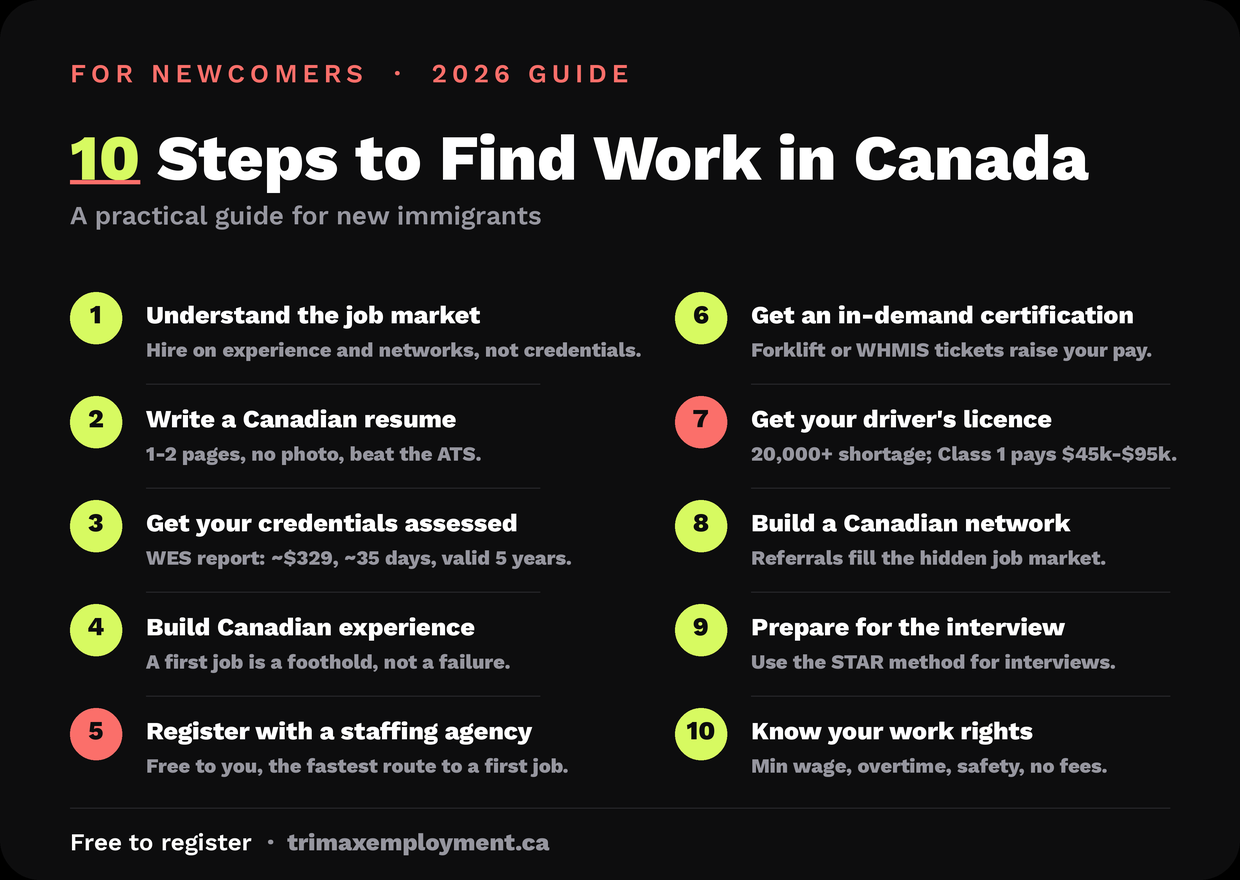
The 10 Steps at a Glance
Frequently Asked Questions
How can a new immigrant find a job in Canada quickly?
The fastest routes are a Canadian-format resume that clears applicant tracking software, getting credentials assessed early, and building Canadian experience straight away, often through a first job or a staffing agency, which is free to you. Getting an in-demand certification (like a forklift licence) or a driver’s licence, and networking through free settlement services, all speed things up. In 2024 immigrant unemployment was about 11% versus 5.6% for Canadian-born workers, so moving fast on these steps matters.
What does a Canadian resume look like?
One to two pages, no photo and no personal details (age, marital status, nationality), achievements shown with numbers, a keyword match to the job posting so it passes applicant tracking software, a clean single-column layout, a Canadian phone number and professional email, and Canadian spelling. Tailor it to each posting. Free resume help is available through government-funded settlement agencies.
Should new immigrants get a driver’s licence in Canada?
Often yes. Many accessible jobs, delivery, courier, warehouse-and-drive, service and trucking, need a valid Canadian licence, and many are closed to you without one. The trucking shortage alone exceeds 20,000 positions per industry estimates, and a commercial Class 1 licence can start drivers around $45,000 to $55,000, rising to $75,000 to $95,000 with experience. Check whether your home licence can be exchanged for a provincial one, then consider a Class 3 (straight truck) or Class 1 (tractor-trailer) if commercial driving fits.
How do I get my foreign credentials recognized in Canada?
Get an Educational Credential Assessment (ECA) to state your qualifications in Canadian terms. A WES assessment costs about CAD $329, takes roughly 35 business days and is valid five years. Check whether your profession is regulated in your province, and use the federal Foreign Credential Recognition Program and the Canadian Information Centre for International Credentials to find who assesses what. Start early, because transcripts from your former institution are the usual delay.
Why do skilled immigrants struggle to find work in Canada?
Mainly because Canadian hiring relies on Canadian experience, references and networks, and because foreign credentials are hard for employers to interpret. In 2024 the immigrant unemployment rate was about 11% versus 5.6% for Canadian-born workers, and around a third of degree-holding recent immigrants are overqualified for their jobs. The fix is adapting to the Canadian system and building local proof quickly, not waiting for foreign credentials to speak for themselves.
Is a survival job or first job a step backward for a newcomer?
No. A first job below your target level is a foothold, not a failure. It produces the Canadian experience, references and workplace track record that employers screen for next, and it pays the bills while you get credentials assessed and network toward your field. Many newcomers use a first job, often through a staffing agency or a driving role, as the bridge to a role in their profession.
Do staffing agencies help new immigrants find work?
Yes, and it is one of the most accessible routes. An agency gets you working and earning Canadian references quickly without requiring a long local history, and in Ontario it is illegal for an agency to charge a worker a fee. Register with two or three. Our guide to working with a staffing agency explains how it works, and our signs an agency is legit checklist helps you avoid the bad ones.
What jobs can new immigrants get without Canadian experience?
Warehousing, logistics, driving and delivery, light manufacturing, general labour, and healthcare-support roles are accessible without a long Canadian history, pay at or above minimum wage, and build the references you need next. A short certification like a forklift licence or WHMIS, or a driver’s licence, raises your pay and employability quickly. Check in-demand roles and pay for your province on the Job Bank.
Do new immigrants have the same work rights as other workers?
Yes. Whatever your immigration status, you are entitled to at least the minimum wage, overtime, a safe workplace and the right to refuse unsafe work, and no staffing agency can charge you a fee. Your rights do not depend on your status, and anyone who says otherwise is trying to exploit you. Confirm what your specific permit allows on the IRCC work pages.
How many immigrants come to Canada each year?
Canada’s 2026 to 2028 Immigration Levels Plan targets about 380,000 new permanent residents a year, roughly 64% through economic categories. It is a competitive market, which is why adapting to how Canada hires, rather than relying on credentials alone, is what separates newcomers who find work fast from those who stall.