
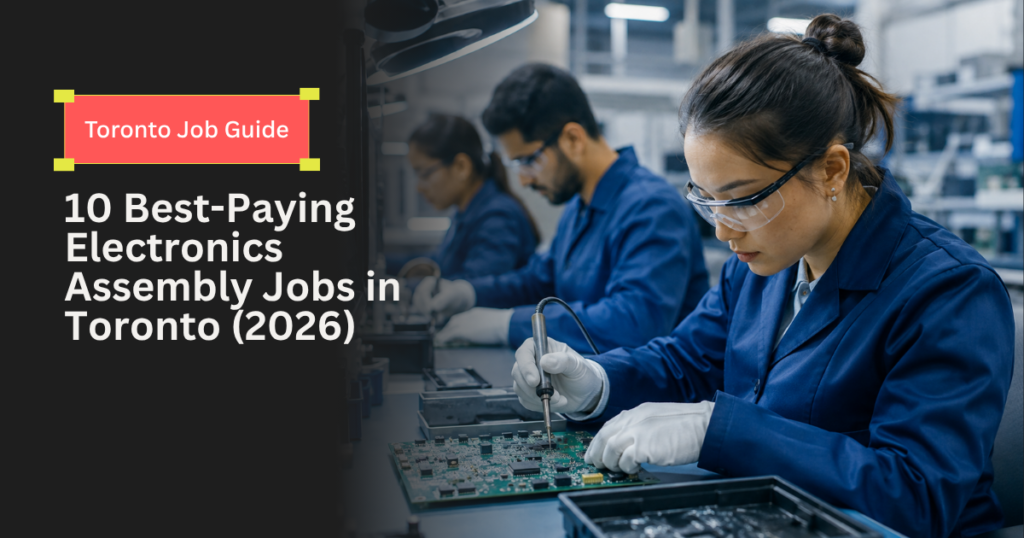
Quick answer: the best-paying electronics assembly jobs in Toronto in 2026 are electronics manufacturing technician, repair and rework technician, test technician, quality-control inspector, production lead, SMT machine operator, IPC-certified soldering technician, PCB assembler, wire-harness and cable assembler, and electronics assembler. Entry assembly roles in the Toronto region start around Ontario’s $17.60 minimum wage and reach the mid $20s an hour, while technician, tester and rework roles run from about $20 to the high $30s or $40 an hour per Job Bank. The single biggest pay lever is an IPC certification (J-STD-001 or IPC-A-610). Here is each role, what it pays in Toronto, what you need, and how to move up.
Toronto is the largest hub for electronics and technology manufacturing in Canada. Contract electronics manufacturers, medical-device makers and industrial-electronics plants are concentrated across the Greater Toronto Area, in Markham, Scarborough, Richmond Hill and Mississauga, and they hire assembly, test and technician staff year-round. For a job seeker, that density means real choice: a range of roles, a clear pay ladder, and employers who will train you on the line.
This guide ranks the ten best-paying electronics assembly roles in Toronto, from entry assembler to technician, with Toronto-region pay from the Government of Canada Job Bank, the certifications that raise your rate, and how to land your first role. If you are new to industrial work, pair it with our guide to entry-level industrial jobs with no experience.
What’s in This Guide
- Where Electronics Assembly Jobs Are in Toronto
- The 10 Best-Paying Electronics Assembly Jobs in Toronto
- How Do You Get Started in Electronics Assembly in Toronto?
- Electronics Assembly Jobs in Toronto at a Glance
- The Bottom Line
- Common Questions From Job Seekers
Where Electronics Assembly Jobs Are in Toronto
The work clusters in the GTA’s tech-manufacturing belt. Most Toronto electronics assembly happens at contract electronics manufacturers (also called EMS providers), medical-device and industrial-electronics companies, concentrated in Markham, Scarborough, Richmond Hill, North York and Mississauga. These plants build and test printed circuit boards, cable and wire harnesses, and finished electronic products for medical, industrial, telecom and consumer markets. Because the sector is dense here, workers can move between employers and up the pay ladder without leaving the region.
Pay starts above minimum and climbs with skill. Every role here starts at or above the Ontario minimum wage of $17.60 an hour in 2026, and rises quickly with a certification or a move into test, inspection or technician work. The figures below are for the Toronto economic region from Job Bank; your exact rate depends on the employer, the shift and your tickets. The fastest way to lift your pay is an IPC certification, the electronics-industry standard for soldering and assembly quality.
It is clean, indoor, year-round work. Electronics assembly is done in clean, climate-controlled plants with anti-static (ESD) controls, not on a loading dock, which many workers prefer. The work runs year-round rather than seasonally, evening and night shifts usually pay a premium, and because Toronto plants build for regulated markets like medical and aerospace, quality and reliability are valued, which rewards workers who show up and hit their standards. For someone who is careful and consistent, it is one of the more comfortable and upwardly mobile ways into GTA manufacturing.
The 10 Best-Paying Electronics Assembly Jobs in Toronto
Ranked from the highest typical pay down, with what you would do, Toronto-region pay per Job Bank, what you need, and how to move up.
1. Electronics Manufacturing Technician
What you would do and what it pays: Set up, calibrate and troubleshoot the equipment and processes on an electronics line, and support engineers with builds and testing. It is the top of the assembly-floor ladder. Job Bank puts electronics technician pay near Toronto at about $19.79 to $40.47 an hour, among the best-paid roles on this list.
What you need and how to get there: A college electronics or electromechanical background helps, but many technicians start as assemblers or testers and move up with experience, an IPC certification and troubleshooting skill. It is the role to aim for once you are on the floor.
2. Electronics Repair and Rework Technician
What you would do and what it pays: Diagnose and repair faulty boards and assemblies, including fine-pitch and surface-mount rework under a microscope. Skilled rework is scarce and well paid, in the electronics technician range of roughly $20 to the high $30s an hour near Toronto.
What you need and how to get there: Steady hands, an IPC-A-610 or J-STD-001 certification, and rework experience. Many reworkers start as soldering technicians and specialise; it is one of the highest-return skills to build in electronics.
3. Electronics Test Technician
What you would do and what it pays: Run functional and in-circuit tests on boards and products, log results and flag failures for rework. Test roles sit at the higher end because they need judgement and equipment skill, toward the upper part of the $19.79 to $40.47 an hour Toronto technician range.
What you need and how to get there: Comfort with test equipment and reading results; a technical certificate or IPC ticket helps. Assemblers who show attention to detail are often moved into test first, which is a common step toward technician pay.
4. Quality Control Inspector (Electronics)
What you would do and what it pays: Inspect boards and assemblies against IPC standards, catch defects before they ship, and document quality. Inspectors earn toward the top of the assembler band and into technician pay, commonly the mid $20s an hour and up in Toronto, per Job Bank.
What you need and how to get there: An IPC-A-610 certification is the key credential for electronics inspection, plus a sharp eye. It is a natural step up from assembler for detail-focused workers.
5. Electronics Production Lead
What you would do and what it pays: Run a line or cell: assign work, keep quality and output on target, train new assemblers and troubleshoot stoppages. Leads earn a premium over the assembler rate, typically the mid $20s an hour and up, on the Toronto electronics assembler scale.
What you need and how to get there: Proven reliability, strong assembly skills and the ability to coach others. Lead-hand roles usually go to the most dependable assemblers, so a strong attendance and quality record is the path.
6. SMT Machine Operator
What you would do and what it pays: Set up and run surface-mount technology (SMT) lines, the pick-and-place and reflow machines that populate circuit boards. It pays in the upper part of the $17.60 to about $24.50 an hour Toronto assembler range, with premiums for off-shifts.
What you need and how to get there: Employers train you on the specific machines; a WHMIS ticket and comfort with equipment help. It is a strong step up from hand assembly and a route toward technician work.
7. IPC-Certified Soldering Technician
What you would do and what it pays: Hand-solder components and assemblies to IPC standards, including fine and through-hole work. Certification lifts pay above general assembly, into the upper assembler range near Toronto and beyond with rework skill.
What you need and how to get there: An IPC J-STD-001 certification is the credential employers pay for. If you can hand-solder cleanly and certify, you move up quickly and open the door to rework and inspection roles.
8. PCB Assembler
What you would do and what it pays: Assemble printed circuit boards: placing and soldering through-hole components, following work instructions and building to spec. Pay sits in the Toronto assembler range of about $17.60 to $24.50 an hour, rising with soldering certification.
What you need and how to get there: Employers train you; good dexterity and attention to detail matter most, and a WHMIS ticket helps. Add an IPC certification and your rate and options both grow.
9. Wire Harness and Cable Assembler
What you would do and what it pays: Build wire harnesses and cable assemblies: cutting, stripping, crimping and terminating wires to drawings, for industrial, automotive and medical products. Pay is in the assembler range starting around $17.60 an hour in Toronto, climbing with speed and accuracy.
What you need and how to get there: No experience needed to start; employers train you on the tools and drawings. Reliability and consistent quality move you up into lead or inspection roles.
10. Electronics Assembler
What you would do and what it pays: The entry point: assemble electronic components and products by hand or with tools, following instructions on a production line. Job Bank puts electronics assembler pay in the Toronto region at about $17.60 to $24.50 an hour.
What you need and how to get there: Employers train you on the job; a WHMIS ticket and steady attendance are what matter. From here, an IPC certification or a move into SMT, test or inspection is the fastest way to raise your pay.
How Do You Get Started in Electronics Assembly in Toronto?
Get ready, add one ticket, and be available. You do not need experience to start on a Toronto electronics line; employers train you. Five steps get you working and moving up:
- 1. Register with a staffing agency. It is free and often the fastest route onto a GTA electronics floor. See our job seeker’s guide.
- 2. Earn a WHMIS ticket. A WHMIS certificate takes hours and is expected on most production floors.
- 3. Aim for an IPC certification. An IPC J-STD-001 or IPC-A-610 ticket is the electronics-industry standard and the clearest way to lift your pay above general assembly.
- 4. Keep a clean, one-page resume. Lead with availability and any tickets, and mirror the words in the posting. See the resume mistakes to avoid.
- 5. Say yes to a shift you can start now. Availability is leverage; workers who can start this week, including evenings, are picked first and convert to permanent fastest.
Electronics Assembly Jobs in Toronto at a Glance
| Role | What you would do | Entry | Toronto pay (Job Bank) |
|---|---|---|---|
| Electronics manufacturing technician | Set up, calibrate, troubleshoot lines | Experience or college | ~$19.79 to $40.47/hr |
| Repair and rework technician | Diagnose and repair boards | IPC + rework skill | ~$20 to high $30s/hr |
| Test technician | Run functional and in-circuit tests | Technical + IPC | upper technician range |
| Quality control inspector | Inspect to IPC standards | IPC-A-610 | mid $20s/hr and up |
| Production lead | Run a line, train, hit targets | Proven assembler | mid $20s/hr and up |
| SMT machine operator | Run pick-and-place / reflow lines | Trained on the job | upper assembler range |
| IPC soldering technician | Hand-solder to IPC standards | IPC J-STD-001 | upper assembler range + |
| PCB assembler | Assemble printed circuit boards | No experience | ~$17.60 to $24.50/hr |
| Wire harness / cable assembler | Cut, crimp, terminate to drawings | No experience | ~$17.60 to $24.50/hr |
| Electronics assembler | Assemble components and products | No experience | ~$17.60 to $24.50/hr |
Sources: Government of Canada Job Bank wage reports for the Toronto economic region (electronics assemblers and electronics technicians). Pay depends on employer, shift and certifications; Ontario’s minimum wage is $17.60 an hour in 2026.
Want an electronics assembly job in Toronto this week? Trimax Employment, a Canadian staffing and workforce management company (Ontario THA licence THA-0000002854), places job seekers into electronics, light-manufacturing and assembly roles across Toronto and the GTA, often within days. It is free to join, every worker is verified through Trimax Verify, and many assignments convert to permanent for reliable workers. Fill out the contact form to join the Trimax talent pool.
The Bottom Line
Toronto’s electronics and technology manufacturing base makes it one of the best places in Canada to build an assembly career. The ten roles here run from entry electronics assembler, starting around Ontario’s $17.60 minimum wage and reaching the mid $20s an hour, up to test, rework and manufacturing technicians earning into the high $30s or $40 an hour per Job Bank. The ladder is clear and the move up is within your control: start as an assembler, earn a WHMIS ticket and then an IPC certification, and step into SMT, test, inspection, rework or lead roles. Register with a reputable staffing agency to get onto a GTA electronics floor fast, and use that first role as the foothold. If you are new to Canada, these roles are also a strong way to gain local experience, as covered in our guide for newcomers.
Frequently Asked Questions
What do electronics assembly jobs pay in Toronto?
Entry electronics assembler roles in the Toronto region pay about $17.60 to $24.50 an hour per Job Bank, starting at Ontario’s $17.60 minimum wage. Test, rework and manufacturing technicians earn more, roughly $19.79 to $40.47 an hour near Toronto. An IPC certification and a move into test or technician work are the main ways to reach the top of the range.
What is the highest-paying electronics assembly job in Toronto?
Among assembly-floor roles, the electronics manufacturing technician and the repair-and-rework technician pay the most, in the $20 to $40 an hour technician range near Toronto. Test technicians and IPC-certified inspectors and reworkers also earn well. All of them are reachable by starting as an assembler and building certifications and skill.
Do I need experience or a certification to start?
No experience is needed for entry assembler, PCB and wire-harness roles; employers train you on the line. A WHMIS ticket is commonly expected, and an IPC J-STD-001 or IPC-A-610 certification is the credential that raises your pay and opens soldering, inspection and rework roles.
Where are electronics assembly jobs in the Toronto area?
Most are at contract electronics manufacturers, medical-device and industrial-electronics companies concentrated in Markham, Scarborough, Richmond Hill, North York and Mississauga. Because the GTA electronics sector is dense, you can move between employers and up the pay ladder without leaving the region. A staffing agency can place you at one of these plants quickly.
How do I move up in electronics assembly?
Start as an assembler, build a strong attendance and quality record, earn an IPC certification, and move into SMT operating, test, inspection, rework or a lead-hand role. Each step raises your pay, and rework and technician skills are the scarcest and best paid. Reliability plus one or two certifications is the fastest path up.
Common Questions From Job Seekers
Do staffing agencies charge workers to find a job?
No. In Canada, legitimate staffing agencies do not charge workers a fee to be placed; the client employer pays the agency. If anyone asks you to pay to get a job, treat it as a red flag. Registering with a reputable agency is free and can be one of the fastest ways to get hired.
How do I get paid when I work through a staffing agency?
The agency is your employer of record: it pays your wages, makes the legal deductions, and issues your pay and payslips. With Trimax Verify, your hours are tracked from a geofenced check-in and flow straight into payroll, so your pay is accurate and on time.
What should I bring to my first shift?
Bring government photo ID, your Social Insurance Number, any tickets you hold (such as WHMIS or IPC), and the personal protective equipment the job requires. Electronics floors often require anti-static (ESD) precautions, which the employer will explain. Arrive early and confirm the start time the day before.
Can a temp job become permanent?
Often, yes. Many electronics and light-manufacturing roles start as temporary or temp-to-hire and convert to permanent for reliable workers. Showing up on time, working safely and hitting your quality targets is what gets you kept on and moved up.
How do I find work with Trimax Employment?
Trimax Employment places job seekers into electronics, manufacturing and light-industrial roles across Toronto and other Canadian cities. Joining is free: fill out the contact form to join the talent pool, or visit the Trimax candidates page to learn more.